I haven't posted in a long time... perhaps since I haven't sailed in a long time.
Looking forward to 2 weeks in Hatteras for a lot of reasons! Staying oceanfront week 1 in Avon, then heading to Rodanthe for week 2, soundfront. It's gonna be sweet!
Bring on the wind!

Thursday, April 19, 2012

Monday, December 05, 2011
Too much rubber.... can't breath....
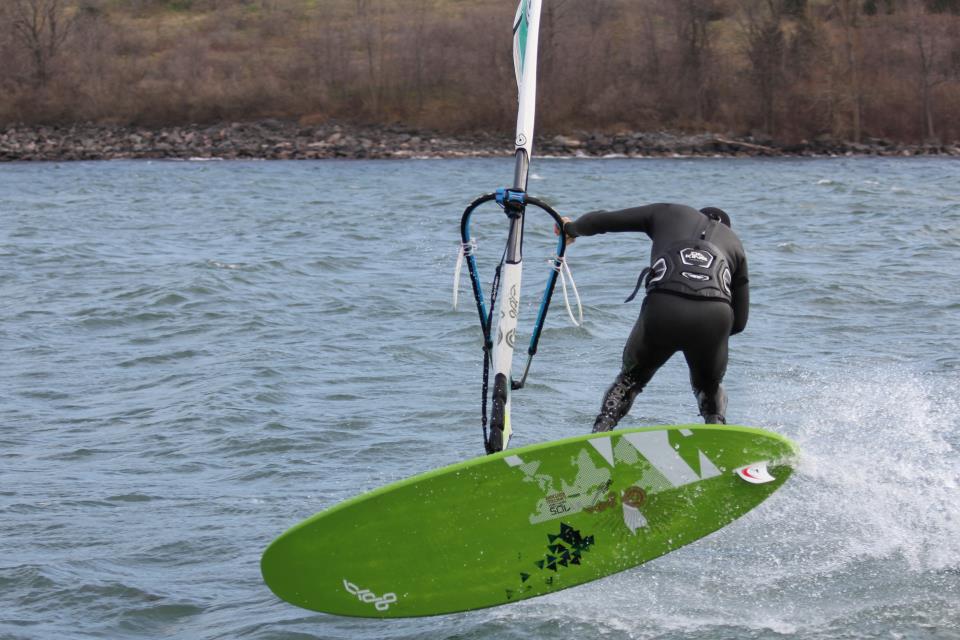
Probably sailed my last session of 2011. Decent day for December, a couple weeks ago - almost 10°C and wind about 20-25kts from the south. Sailed at RMC with my buddy Greg, a virtual spa for windsurfing. Other clubs should take note of how awesome this place is.
The Session
To be honest, I've had better sessions, but damn, how often can you sail in 10°C air in December! What a treat. It was a bit light to start off, but soon ramped up to decent 4.7. The chop cleans up nicely as it enters the bay, so generally, you either have relatively flat water, or nice small rollers. It's pretty clean, and definitely satisfies a freestylers demands for a nice mix of flat, but with the odd ramp for shove-its and loopage.
Quite bizarre, but I've landed more 540's here than anywhere else, but I'd say I've never landed a single grubby. Something is wrong with me.
One thing that is noteworthy. The rubber. Oh my god the rubber. It is for sure a novelty to sail this late, but in one way, its a huge pain in the ass. All that damn rubber to put on, take off, and generally withstand for the whole session. It makes it very hard to breath, never mind sense where your feet are...
The RMC Windsurfing Club
The RMC Windsurf Club is situated in the Royal Military College (RMC) in Kingston, sandwiched between the outlet of the Great Cataraqui River to the west, and Navy Bay and Fort Henry to the East. It's a small bay, maybe 250 m wide or so, and tucked away just a bit so the place works best on a southerly, but you can still get out to the main Kingston Harbour on a southwester.
So what is so special about the place? Well, first off, it's actually got a bit of a scene going with lots of keen cadets partaking at any time of the year (consider Mark, another sailor out yesterday, learning waterstarts in ~8°C water). This is quite remarkable for Kingston, where the scene has dwindled to a select few holdouts, including moi. The place is situated on a rocky shoreline, but alas, connect together a whack of floating docks and voila, you have the easiest launch on the planet. Step right on the board and go!!! Now, tack onto that a clubhouse building with rigging space for a couple sails, an anemometer, a hot shower, and a sound system, and BOOM! Deeluxe! It's a pleasure to sail here!
Wanna know what else? It's a club, complete with lots of learning kit, and its open to the public. Talk about a sweet place to learn! I think this website is a bit old, but check it out here: http://www.rmcwindsurfing.com/
Other
I think Greg, Mark and Gen sailed again yesterday, Dec 15. Cranking southerlies again, probably 30kts +. Hardcore for sure! Happy Santa sail guys!
 |
| RMC in early December... Photo by Craig Butler |
The Session
To be honest, I've had better sessions, but damn, how often can you sail in 10°C air in December! What a treat. It was a bit light to start off, but soon ramped up to decent 4.7. The chop cleans up nicely as it enters the bay, so generally, you either have relatively flat water, or nice small rollers. It's pretty clean, and definitely satisfies a freestylers demands for a nice mix of flat, but with the odd ramp for shove-its and loopage.
Quite bizarre, but I've landed more 540's here than anywhere else, but I'd say I've never landed a single grubby. Something is wrong with me.
One thing that is noteworthy. The rubber. Oh my god the rubber. It is for sure a novelty to sail this late, but in one way, its a huge pain in the ass. All that damn rubber to put on, take off, and generally withstand for the whole session. It makes it very hard to breath, never mind sense where your feet are...
 |
| Gregger ripping a jibe on the inside. RMC. Photo: Craig Butler |
The RMC Windsurfing Club
The RMC Windsurf Club is situated in the Royal Military College (RMC) in Kingston, sandwiched between the outlet of the Great Cataraqui River to the west, and Navy Bay and Fort Henry to the East. It's a small bay, maybe 250 m wide or so, and tucked away just a bit so the place works best on a southerly, but you can still get out to the main Kingston Harbour on a southwester.
So what is so special about the place? Well, first off, it's actually got a bit of a scene going with lots of keen cadets partaking at any time of the year (consider Mark, another sailor out yesterday, learning waterstarts in ~8°C water). This is quite remarkable for Kingston, where the scene has dwindled to a select few holdouts, including moi. The place is situated on a rocky shoreline, but alas, connect together a whack of floating docks and voila, you have the easiest launch on the planet. Step right on the board and go!!! Now, tack onto that a clubhouse building with rigging space for a couple sails, an anemometer, a hot shower, and a sound system, and BOOM! Deeluxe! It's a pleasure to sail here!
Wanna know what else? It's a club, complete with lots of learning kit, and its open to the public. Talk about a sweet place to learn! I think this website is a bit old, but check it out here: http://www.rmcwindsurfing.com/
Other
I think Greg, Mark and Gen sailed again yesterday, Dec 15. Cranking southerlies again, probably 30kts +. Hardcore for sure! Happy Santa sail guys!
Thursday, October 20, 2011
Weekend was a ripper!
Killer weekend. Finally. The shite year-of-sucky-wind seems like a long time ago after this past weekend.
Saturday: 35-45kts SW. Sailed Mac's at Sandbanks. Not as clean as I've seen it, but love sailing op'ed 3.7 since that extra power is helpful in getting back at the wave for a smack.
Sunday: 25kts ish, WSW. Sailed Mac's a bit again, but tired from Saturday. This fat ass is a bit much for 4.7 on a 76L waveboard.
Monday: 30-45kt treat, WSW. Sailed Emily St in Kingston with my old mates for a change. Great times! Started off in solid 4.2 in building waves, then nuked to op'ed 3.7 again and the place just lit up. Big rollers for jibing on the outside, making them oh-so-smooth, then legit frontside waves on the inside for 1 or 2 hits full power. Loved it!
Thanks to Craig Butler for the photos. Some more of his are here:
http://www.flickr.com/photos/wavespirephoto/
Sandbanks:

 Emily Street:


Saturday: 35-45kts SW. Sailed Mac's at Sandbanks. Not as clean as I've seen it, but love sailing op'ed 3.7 since that extra power is helpful in getting back at the wave for a smack.
Sunday: 25kts ish, WSW. Sailed Mac's a bit again, but tired from Saturday. This fat ass is a bit much for 4.7 on a 76L waveboard.
Monday: 30-45kt treat, WSW. Sailed Emily St in Kingston with my old mates for a change. Great times! Started off in solid 4.2 in building waves, then nuked to op'ed 3.7 again and the place just lit up. Big rollers for jibing on the outside, making them oh-so-smooth, then legit frontside waves on the inside for 1 or 2 hits full power. Loved it!
Thanks to Craig Butler for the photos. Some more of his are here:
http://www.flickr.com/photos/wavespirephoto/
Sandbanks:


Thursday, October 13, 2011

Tuesday, September 20, 2011
'Rip'-hood to Fatherhood - The whole thing.
Here is the complete Rip-hood to Fatherhood article, as per my previous 3 posts, but available as a much easier to read PDF. Enjoy.
LINK
LINK
Wednesday, September 14, 2011
'Rip'-hood to Fatherhood Part 3/3
Well, this is the last of it. If you've enjoyed the write-up, let me know in the comments please. Feedback appreciated.


Tuesday, September 13, 2011
My day so far
Great forecast, long wind-drought, left-over vacation time...
Here's my day, and I hate to say that this is only "so far"... because I am a sucker for self-abuse.

Yes, that is how I like to use up my left-over vacation time.
Update:
Home with beer in hand, shotgun in lap ;)
Skunk number 3. Sucker for punishment. I am officially done chasing shit. I'm going to pack the kite stuff from now on.

Here's my day, and I hate to say that this is only "so far"... because I am a sucker for self-abuse.

Yes, that is how I like to use up my left-over vacation time.
Update:
Home with beer in hand, shotgun in lap ;)
Skunk number 3. Sucker for punishment. I am officially done chasing shit. I'm going to pack the kite stuff from now on.

Monday, August 22, 2011


Friday, August 12, 2011
'Rip'-hood to Fatherhood Part 1/3
Sorry about the .jpg format - can't think of any better way to do it!
Any suggestions? Blogger formatting capabilities are pretty weak.
Anyway, enjoy...


Part 2/3 coming soon.... To Delivery, and Beyond!
Any suggestions? Blogger formatting capabilities are pretty weak.
Anyway, enjoy...


Part 2/3 coming soon.... To Delivery, and Beyond!
Sunday, August 07, 2011
Some day....
Some day we'll get some wind and I can post something again. For now it would all have to be woodworking topic (built an outdoor shower), web browsing, and some stand-up paddling.
Coming soon... part 1 of an article on Parenthood vs. Windsurfing. Guess who wins?

Coming soon... part 1 of an article on Parenthood vs. Windsurfing. Guess who wins?

Wednesday, June 22, 2011
Memories of Hatteras

Not a whole lot of action around here to speak of, so just have to rely on my memory of windsurfing being a fun sport with a photo to prove it! Thanks for the photo Steve! Check out some of Steve's other work here.
Oh yeah, Father's Day camping weekend at Sandbanks was great! No wind, but lots of sand all over.

Sunday, May 08, 2011
Nope, this is not me on the purple kite... I swear.

I'm not sure how kiting will fit into my world, especially around Kingston (now that we've been spoiled by shallow water & warm Hatteras conditions), but it is fun, and very different.
This is a shot of me during about my 3rd hour of water time with the kite. After about 2-3hrs on the water, I was semi-managing to stay upwind, turning to toe-side, and shlogging through some 'jibes' (if that is what they are called in this shorts-over-wetsuit world of kiteboarding). Yes, I am still a windsurfer and feel like I need to continue taking shots at teabaggers ;)
All in all, great trip to Hatteras. First week we stayed in Avon with Amine Fadous and family from Montreal. Had great wind most of the week culminating with a great ocean-side sail at Ramp30. Second week we were up in Rodanthe for the first time, with Peter Williamson and family from Ottawa. For sure a bit less variation for windsurfing (a bit too shallow, resulting in a bad shoulder check to the sand bottom), but far superior for kiting. This gave Cheryl and I a chance to play! I'd say we had wind enough for either sport probably about 12/14 days. Nice.
A few things can be said for the (mainly Ottawa-based) kiting community that surrounded us up in Rodanthe - they are super helpful, super friendly and always willing to give pointers to beginners. Cheryl and I both felt immensely safe learning in that environment, and we owe a big thanks for the many launches, relaunches, good vibes, words of encouragement, and rescues in the Pamlico Sound.
Update May 16 - Here is a great photo compilation of the Ottawa crew up in Rodanthe by Steve Slaby! Great work Steve!
http://www.vimeo.com/23769102
Saturday, April 30, 2011
Fun on the sound...
Wish I had some shots of Ramp30 action, but unfortunately I have none. Had a great time with Amine at Ramp30 on Thursday - blowing about 30-35, sailed a 4.2 for some extra grunt in the impact zone. I find sailing ocean side in Hatteras is ALWAYS a big challenge - it's always a bit holey on the inside leaving you for dead just when you need to be planing. Playing on the waves more to the inside always leaves you questioning how early you should be bailing.
Took some early breaks after some major kookery, but then managed to get somewhat of a groove on and made fewer mistakes. Fun times. Had some nice 3-4 turn waves with a few aerial attempts, skipped the loopery and just made the most of the waves.
Anyway, here is a spock photo from the sound. We've been getting great wind til now and sailed almost everyday on anything from 5.3 down to 4.2.

Took some early breaks after some major kookery, but then managed to get somewhat of a groove on and made fewer mistakes. Fun times. Had some nice 3-4 turn waves with a few aerial attempts, skipped the loopery and just made the most of the waves.
Anyway, here is a spock photo from the sound. We've been getting great wind til now and sailed almost everyday on anything from 5.3 down to 4.2.

Thursday, April 21, 2011
Not too shabby...

By the time we get around to scoring that purple, I'm sure my hands will be destroyed!
Damn pansy work hands...
Stoked to be getting on the water very soon!
Monday, March 07, 2011
Hatteras Season is almost here!
Totally curious if there are other 'Hatteras Pilgimage' rituals elsewhere in the world?
For those readers from far off places (I am assuming there might be one or two if I am lucky), I wonder if other sailors elsewhere in the world have a similar ritual.
The background: Canada is not known for its tropical nature. Relatively speaking, it gets cold here, damn cold. Generally cold enough that the water vanishes into solid sheets of ice forming an impenetrable barrier between us and our medium. Picture a smoker desperately eyeing a cigarette behind a solid glass window. That is us in the winter.
Generally speaking, most people around here are not willing to battle the extreme colds of the transition seasons, so a standard sailing season for a reasonably dedicated sailor is typically May (earliest), through November (latest). Outside that window, the water is unbearable for most, or the air is just too frigid. This leaves a hideously long off-season, bordering on 6 months or hair-pulling insanity. I imagine if a windsurfer were a smoker wanting to quit, it would be dead easy. We deal with severe withdrawal symptoms every damn year!
Hatteras gets nice and windy in the spring. With all these lost souls in desperation of wind and water, somethings gotta give. Fortunately, it's only about 12-16hrs of driving (depending on roughly where you live up here), rental homes are cheap, and its reasonably warm and windy! A win-win for all. Typically you see more Quebec and Ontario license plates in Avon in late April than NC plates! We INVADE the place, and love it!

That season is almost here... We've got a couple weeks booked in the spring and totally ready to pounce. Cheryl is going to work on her kiting a bit more and hopefully I can get working on some new tricks. Totally stoked! One week in Avon, one week in Rodanthe!
What do others out there do to satiate their winter-time jitters?
Thanks for those great photos last spring Steve! (Steve Slaby, 2010)
For those readers from far off places (I am assuming there might be one or two if I am lucky), I wonder if other sailors elsewhere in the world have a similar ritual.
The background: Canada is not known for its tropical nature. Relatively speaking, it gets cold here, damn cold. Generally cold enough that the water vanishes into solid sheets of ice forming an impenetrable barrier between us and our medium. Picture a smoker desperately eyeing a cigarette behind a solid glass window. That is us in the winter.
Generally speaking, most people around here are not willing to battle the extreme colds of the transition seasons, so a standard sailing season for a reasonably dedicated sailor is typically May (earliest), through November (latest). Outside that window, the water is unbearable for most, or the air is just too frigid. This leaves a hideously long off-season, bordering on 6 months or hair-pulling insanity. I imagine if a windsurfer were a smoker wanting to quit, it would be dead easy. We deal with severe withdrawal symptoms every damn year!
Hatteras gets nice and windy in the spring. With all these lost souls in desperation of wind and water, somethings gotta give. Fortunately, it's only about 12-16hrs of driving (depending on roughly where you live up here), rental homes are cheap, and its reasonably warm and windy! A win-win for all. Typically you see more Quebec and Ontario license plates in Avon in late April than NC plates! We INVADE the place, and love it!

That season is almost here... We've got a couple weeks booked in the spring and totally ready to pounce. Cheryl is going to work on her kiting a bit more and hopefully I can get working on some new tricks. Totally stoked! One week in Avon, one week in Rodanthe!
What do others out there do to satiate their winter-time jitters?
Thanks for those great photos last spring Steve! (Steve Slaby, 2010)
Thursday, December 02, 2010
2010 Year End...
I hate when this happens, but sure enough it always does. It gets frickin' cold and the water gets real hard. Seems to do it every year around this time... funny that.
So, recap of the year? Certainly some positives and negatives:
- Great stint in Hatteras in early May and finally made the effort to meet & sail with some locals, including Andy McKinney of Wind-NC, Olaf Podehl of Avon Sail House and Bill Bell of OBX Beachlife and the Hatteras Wave Jam. Certainly had some fun times playing with my buddy Amine in the sound, exchanging tricks in close proximity.
- Got my boys Jalen and Bradley out for their first rides!! Totally stoked on that!

- Sailed some perfect flat water in Shippagan with Eric Girard of Club Wind & Kite and buddy boosting big airs all around. Also had a wicked fun session at Haut-Shippagan, all by myself, again in strong wind, near dead flat (btw: this is very nice for freestyle!).
- Some of the best Sandbanks sessions of my life shared with a whole slew of new friends from Quebec! First one in early September (had to delay our departure for Shippagan for that one!), and another banger in October.
Unfortunately, on the downside, a couple of things:
- I gotta get back into shape!! I've yet to establish a reasonable balance between family-man Dad and active healthy adrenaline-chaser. Challenging. The result: I'm tiring out way quicker than I used to (I used to be the king of 3-4 hr sessions with no breaks) but probably even worse, I'm having a lot more close calls with serious ankle, leg and shoulder injuries. If I hope to progress further with freestyle, this can't continue.
- I learned nothing new. I've had the same goals of learning some new tricks, including flakas, pushies and shakas, whichever one, whichever order, I don't care... I just need something new to help me keep the stoke. It is becoming quite clear that it's the progression that keeps me interested and coming back for more. Not sure what will happen as that progression naturally slows down - and it seems to be!!
Lastly, I have been working with a few others to get an article or two published in Windsport, but to date, no luck. Fingers are crossed that something will materialize in the new year.
All in all, a decent year, but definitely need to get my ass in shape for next year. Cheryl and I are committing to do 3-5 orienteering/adventure races next year, so I think inherent in that will be getting to where I need to be in terms of cardiovascular fitness and flexibility. We're starting fresh in the spring with the long version of the Giant Rib's Raid, a 23-25km orienteering run.
So, recap of the year? Certainly some positives and negatives:
- Great stint in Hatteras in early May and finally made the effort to meet & sail with some locals, including Andy McKinney of Wind-NC, Olaf Podehl of Avon Sail House and Bill Bell of OBX Beachlife and the Hatteras Wave Jam. Certainly had some fun times playing with my buddy Amine in the sound, exchanging tricks in close proximity.
- Got my boys Jalen and Bradley out for their first rides!! Totally stoked on that!

- Sailed some perfect flat water in Shippagan with Eric Girard of Club Wind & Kite and buddy boosting big airs all around. Also had a wicked fun session at Haut-Shippagan, all by myself, again in strong wind, near dead flat (btw: this is very nice for freestyle!).
- Some of the best Sandbanks sessions of my life shared with a whole slew of new friends from Quebec! First one in early September (had to delay our departure for Shippagan for that one!), and another banger in October.
Unfortunately, on the downside, a couple of things:
- I gotta get back into shape!! I've yet to establish a reasonable balance between family-man Dad and active healthy adrenaline-chaser. Challenging. The result: I'm tiring out way quicker than I used to (I used to be the king of 3-4 hr sessions with no breaks) but probably even worse, I'm having a lot more close calls with serious ankle, leg and shoulder injuries. If I hope to progress further with freestyle, this can't continue.
- I learned nothing new. I've had the same goals of learning some new tricks, including flakas, pushies and shakas, whichever one, whichever order, I don't care... I just need something new to help me keep the stoke. It is becoming quite clear that it's the progression that keeps me interested and coming back for more. Not sure what will happen as that progression naturally slows down - and it seems to be!!
Lastly, I have been working with a few others to get an article or two published in Windsport, but to date, no luck. Fingers are crossed that something will materialize in the new year.
All in all, a decent year, but definitely need to get my ass in shape for next year. Cheryl and I are committing to do 3-5 orienteering/adventure races next year, so I think inherent in that will be getting to where I need to be in terms of cardiovascular fitness and flexibility. We're starting fresh in the spring with the long version of the Giant Rib's Raid, a 23-25km orienteering run.
Friday, November 19, 2010
Canadian Windsurfers...
You can say all you want about how lame Facebook is, but when it comes down to bringing together like-minded individuals on a cause, it has rapidly become the undisputed King.
Ilan has set up a Facebook page for Canadian Windsurfers. Check it out here.

Hopefully this page can act as a bit of a resource to reach out to even more people, from Canada or abroad, to join the Canadian Windsurfing Community in addressing issues of access, water quality, safety, you name it, things that effect us windsurfers in Canada.
Hopefully this page can act as a bit of a resource to reach out to even more people, from Canada or abroad, to join the Canadian Windsurfing Community in addressing issues of access, water quality, safety, you name it, things that effect us windsurfers in Canada.
The most recent problem is Air Canada's baggage regulations and their prohibition of windsurfing gear on its flights. Not only can you find some info on the new facebook page, but if you'd like to sign a petition to work towards overturning these regulations, please go straight here: http://www.thepetitionsite.com/1/aircanadawindsurfpolicy/
I sure wish this was around when we were attempting to deal with Transport Canada and their dumb-ass PFD requirements...
Friday, November 12, 2010
Wave Theory and Principles Interpretted. Part II
div>In Part I, I just spoke a bit about a few terminology clarifications, how wind duration and fetch affect the quality of the waves and also a few tidbits on wave power and speed.
Here's a beauty hack at the lip by Pierre Morneau from Montreal, at Sandbanks last fall. Great shot by Nic Chapleau. Pierre rips.


So, when I talk about waves "feeling" bottom, it means that the bottom is interfering with the orbit of the water particles and hence the orbits become non-circular, and more horizontally stretched as ellipses. Again, keep in mind this is all theoretical and not a whole lot in real-life will look much like this due to so many other factors.
Here's one of my faves of me from last year, by Ilan Artzy. I like the spray on this bottom turn. Not a huge wave or anything like that, but a fun one nonetheless.

Two things happen when waves begin to interact with the bottom: 1) Refraction & 2) Shoaling.
1) Refraction. Wave refraction is a change in direction of the wave due to a change in speed. Picture in your mind a wave coming side-onshore (like in the photo below, from the southeast). As the wave front/crest starts to enter shallow water, it will begin to slow down. Now imagine this happening along the whole wave crest. The wave crest will start bending since the part of the wave nearest shore will have wrapped/bent more than the part of the wave further offshore (because it has slowed down the most).
 Ultimately, waves tend towards shore such that the wave crests will ultimately strike parallel to the shoreline (or in different terms, the wave ray will tend towards perpendicular to the shoreline).
The end result is that waves bend to become almost perfectly onshore by the time they hit the actual shoreline. See image. For those Sandbanks regulars – this is very important to us!!! Without refraction the wave action at Sandbanks would be pretty damn lame – it is the refraction that turns on-shore conditions into our pseudo-'side-shore' conditions.
 And here is a diagram of a wave wrapping around an island. Suffice to say that sailing in lee of the island would suck for a couple of reasons: No wind & messy waves!

2) Shoaling. Another thing happens when waves start to touch bottom. As the bottom begins to interfere with the circular motion of water particles under wave action, the shape of the waves begins to change and this is called shoaling. The shallower the water gets, the more the waves shoal, or bunch-up and steepen (jack up) until ultimately they break. This is a pretty intuitive transformation that most anyone who has watched a wave will recognize and understand: As waves approach shore, they will appear to jack up and get bigger and ultimately break in one form or another. The bigger the wave, the further out it will break. It is pretty obvious to most people that the bigger waves at Sandbanks are further out from the beach, or further upwind near West Point, because they haven't shoaled as much, or for as long, and thus have more of their original energy left.
Here is a wiki on the topic of wave shoaling, with a really neat little graphic that shows the process and impact of shoaling on wave height and wavelength (By Régis Lachaume). See below (its a 2Mb .GIF, so I hope it uploads for you).
 (ahh, sorry, looks like animated .gifs don't work in Blogger blogs...)
Another couple of things can happen to waves as they travel through water. They can interact with features they encounter. The refraction and shoaling mentioned above fit this category, with respect to natural shorelines and lake-bottom. Another couple examples of wave transformation are: 3) Reflection and 4) Diffraction.
3) Reflection. If you have ever had the pleasure of sailing in front of the ‘PUC dock’ in Kingston, you’ll know what this is all about. In fact, this is what makes Emily St (Richardson Beach) in Kingston much messier than locations further upwind. When waves strike an object that is unable to absorb its energy (virtually all things), some amount of the wave energy is reflected, or bounces back off that object. This can happen straight on or at an angle to the object. When a wave hits something like a concrete vertical breakwall head on, a considerable portion of the incident wave energy can be reflected back from whence the wave came. This creates a nasty mess of standing waves, or waves that appear to be stationary and pop out of no where. You don’t want to be sailing anywhere near there unless you are experienced in rodeo. All surfaces do reflect some energy, even a sand beach. The least wave-reflective shorelines in nature are likely extremely long, gently-sloped sand beaches and vegetated shorelines such as coastal wetlands. Anything man made or hard tends to reflect energy in a nasty way. So, a big two thumbs down for shitty breakwall design!!
4) Diffraction. Diffraction is the bending of waves around an obstacle in their path, or through an opening. I won’t talk much about this but it is a pretty neat phenomenon. One of our most beloved bloggers Giampaolo (Maui Surf Report) mentions the odd surf session scored in Kahului Harbour. Since I have never actually seen the spot, I looked it up on Google Maps (in fact, I used a NOAA free website called 'Geogarage Marine', which can overlay available marine bathymetry charts under Google Maps aerials - really neat!) . Generally, as waves enter a harbor gap like that, they start to spread out radially from the entrance, resulting in a down-size in wave and wave power as the energy disperses through the harbour. Think of it this way: You have a harbor gap that is about 200ft wide that allows energy to pass through and then dissipate throughout a harbor that is about 1000ft wide or more. I imagine when huge waves are pounding the North Shore of Maui and closing out everything, maybe that harbor still works for surfers since the waves go from deep to shallow fairly quick and the big stuff doesn’t make it through, plus you may have smaller waves getting in, wrapping nicely. Just a guess.


... and heres another shot from last fall. Nothing spectacular about the action, but just looking past that to the bomb in the back that no one is riding!!

Here's a beauty hack at the lip by Pierre Morneau from Montreal, at Sandbanks last fall. Great shot by Nic Chapleau. Pierre rips.

Part II is all about wave transformation, or, how a wave changes when it encounters features in the lake, sea or ocean, things like the bottom, the shoreline and man-made structure. This is the magic that makes a place like Sandbanks work for us! But, I do stop short at wave breaking, which I will leave to a bonus Episode III - joy for all!!
So, to continue with the lecture; As waves begin to enter shallower water, they begin to ‘feel bottom’, and start to transform. Their motion and progress becomes compromised by the bathymetry (sea floor topography) and shape of the shoreline.
Deep-water waves (within small amplitude wave theory) are basically comprised of water particles making circular motions. The diameter of the rotation is largest at the surface and gets smaller as you go down from the surface, to the point there is no movement at a depth of roughly half the wavelength. The next diagram shows these orbits in both shallow and deep-water, but it is perhaps better understood looking at Fig9.5 in this Google Book, called Essentials of Oceanography by Tom Garrison (I didn't want to copy it in here due to copyright infringement, but its a good little diagram).

So, when I talk about waves "feeling" bottom, it means that the bottom is interfering with the orbit of the water particles and hence the orbits become non-circular, and more horizontally stretched as ellipses. Again, keep in mind this is all theoretical and not a whole lot in real-life will look much like this due to so many other factors.
Here's one of my faves of me from last year, by Ilan Artzy. I like the spray on this bottom turn. Not a huge wave or anything like that, but a fun one nonetheless.

Two things happen when waves begin to interact with the bottom: 1) Refraction & 2) Shoaling.
1) Refraction. Wave refraction is a change in direction of the wave due to a change in speed. Picture in your mind a wave coming side-onshore (like in the photo below, from the southeast). As the wave front/crest starts to enter shallow water, it will begin to slow down. Now imagine this happening along the whole wave crest. The wave crest will start bending since the part of the wave nearest shore will have wrapped/bent more than the part of the wave further offshore (because it has slowed down the most).
 Ultimately, waves tend towards shore such that the wave crests will ultimately strike parallel to the shoreline (or in different terms, the wave ray will tend towards perpendicular to the shoreline).
The end result is that waves bend to become almost perfectly onshore by the time they hit the actual shoreline. See image. For those Sandbanks regulars – this is very important to us!!! Without refraction the wave action at Sandbanks would be pretty damn lame – it is the refraction that turns on-shore conditions into our pseudo-'side-shore' conditions.
 And here is a diagram of a wave wrapping around an island. Suffice to say that sailing in lee of the island would suck for a couple of reasons: No wind & messy waves!
2) Shoaling. Another thing happens when waves start to touch bottom. As the bottom begins to interfere with the circular motion of water particles under wave action, the shape of the waves begins to change and this is called shoaling. The shallower the water gets, the more the waves shoal, or bunch-up and steepen (jack up) until ultimately they break. This is a pretty intuitive transformation that most anyone who has watched a wave will recognize and understand: As waves approach shore, they will appear to jack up and get bigger and ultimately break in one form or another. The bigger the wave, the further out it will break. It is pretty obvious to most people that the bigger waves at Sandbanks are further out from the beach, or further upwind near West Point, because they haven't shoaled as much, or for as long, and thus have more of their original energy left.
Here is a wiki on the topic of wave shoaling, with a really neat little graphic that shows the process and impact of shoaling on wave height and wavelength (By Régis Lachaume). See below (its a 2Mb .GIF, so I hope it uploads for you).

 (ahh, sorry, looks like animated .gifs don't work in Blogger blogs...)
Another couple of things can happen to waves as they travel through water. They can interact with features they encounter. The refraction and shoaling mentioned above fit this category, with respect to natural shorelines and lake-bottom. Another couple examples of wave transformation are: 3) Reflection and 4) Diffraction.
3) Reflection. If you have ever had the pleasure of sailing in front of the ‘PUC dock’ in Kingston, you’ll know what this is all about. In fact, this is what makes Emily St (Richardson Beach) in Kingston much messier than locations further upwind. When waves strike an object that is unable to absorb its energy (virtually all things), some amount of the wave energy is reflected, or bounces back off that object. This can happen straight on or at an angle to the object. When a wave hits something like a concrete vertical breakwall head on, a considerable portion of the incident wave energy can be reflected back from whence the wave came. This creates a nasty mess of standing waves, or waves that appear to be stationary and pop out of no where. You don’t want to be sailing anywhere near there unless you are experienced in rodeo. All surfaces do reflect some energy, even a sand beach. The least wave-reflective shorelines in nature are likely extremely long, gently-sloped sand beaches and vegetated shorelines such as coastal wetlands. Anything man made or hard tends to reflect energy in a nasty way. So, a big two thumbs down for shitty breakwall design!!
4) Diffraction. Diffraction is the bending of waves around an obstacle in their path, or through an opening. I won’t talk much about this but it is a pretty neat phenomenon. One of our most beloved bloggers Giampaolo (Maui Surf Report) mentions the odd surf session scored in Kahului Harbour. Since I have never actually seen the spot, I looked it up on Google Maps (in fact, I used a NOAA free website called 'Geogarage Marine', which can overlay available marine bathymetry charts under Google Maps aerials - really neat!) . Generally, as waves enter a harbor gap like that, they start to spread out radially from the entrance, resulting in a down-size in wave and wave power as the energy disperses through the harbour. Think of it this way: You have a harbor gap that is about 200ft wide that allows energy to pass through and then dissipate throughout a harbor that is about 1000ft wide or more. I imagine when huge waves are pounding the North Shore of Maui and closing out everything, maybe that harbor still works for surfers since the waves go from deep to shallow fairly quick and the big stuff doesn’t make it through, plus you may have smaller waves getting in, wrapping nicely. Just a guess.

Alright, so the next few photos are just some gratuitous shots from Sandbanks, and don't have a whole lot to do with anything except for waves!!
Bottom turn by Pierre (photo by Nic):

... and heres another shot from last fall. Nothing spectacular about the action, but just looking past that to the bomb in the back that no one is riding!!

Wave Theory and Principles Interpretted. Part I
Following on my undergraduate education, I studied coastal engineering in more depth for my Masters of Science degree. This is part 1 of a 2 part blog post on some of the basics of waves.
A lot of good useful information for us windsurfers comes from “Small Amplitude Wave Theory”, which is one of the most simple and most widely applicable mathematic principals for quantifying the movement of waves. There are many other theories as well, each having their place. I studied this stuff for a few years, way back in my university days and have forgotten most of it, aside from the basic principles that apply to our beloved Lake Ontario. Despite immersing myself in Coastal Engineering, somehow I still ended up living on a lake, rather than say an ocean, where arguably I should be residing. But, I digress…
Here's a shot of Guy Trudeau at Mac's last year, taken by Nic Chapleau. Looks like a sweet wave to me!

Here is a link to the wiki on the topic. http://en.wikipedia.org/wiki/Water_waves
So, without getting into all the crazy math containing far too many greek symbols, which I have long since forgotten anyway, here are some of the more basic wave principles and observations I took away from all this education, as they relate to Lake Ontario and Sandbanks.
• What is 'Swell'? First off, some terminology: Lake waves, by definition, are not “swell”. Lake waves are more accurately referred to as “locally-generated seas”, or in other words, waves produced by the action of the wind itself, locally. Some refer to this as “wind swell”, which kinda makes sense, but there is actually no true "swell" on the Great Lakes. Swell, by definition, is wave action created by distant wind events. By travelling long distances and moving away from the storm, the waves become much more organized with longer periods, wavelength and speed. In particular, storms send their higher energy, lower frequency waves further abroad, and this is true ‘swell’. Despite the Great Lakes being pretty dang big pools, they are generally too small for true ‘swell’, and generally too small for tides as well.
A lot of good useful information for us windsurfers comes from “Small Amplitude Wave Theory”, which is one of the most simple and most widely applicable mathematic principals for quantifying the movement of waves. There are many other theories as well, each having their place. I studied this stuff for a few years, way back in my university days and have forgotten most of it, aside from the basic principles that apply to our beloved Lake Ontario. Despite immersing myself in Coastal Engineering, somehow I still ended up living on a lake, rather than say an ocean, where arguably I should be residing. But, I digress…
Here's a shot of Guy Trudeau at Mac's last year, taken by Nic Chapleau. Looks like a sweet wave to me!

Here is a link to the wiki on the topic. http://en.wikipedia.org/wiki/Water_waves
So, without getting into all the crazy math containing far too many greek symbols, which I have long since forgotten anyway, here are some of the more basic wave principles and observations I took away from all this education, as they relate to Lake Ontario and Sandbanks.
• What is 'Swell'? First off, some terminology: Lake waves, by definition, are not “swell”. Lake waves are more accurately referred to as “locally-generated seas”, or in other words, waves produced by the action of the wind itself, locally. Some refer to this as “wind swell”, which kinda makes sense, but there is actually no true "swell" on the Great Lakes. Swell, by definition, is wave action created by distant wind events. By travelling long distances and moving away from the storm, the waves become much more organized with longer periods, wavelength and speed. In particular, storms send their higher energy, lower frequency waves further abroad, and this is true ‘swell’. Despite the Great Lakes being pretty dang big pools, they are generally too small for true ‘swell’, and generally too small for tides as well.
Consider this to be the first problem for us windsurfers. In the Great Lakes, it means that waves and wind will generally travel in the same direction = on-shore conditions. In a place like the north shore of Maui, waves are often direct onshore, while the wind is sideshore - a much better recipe for fun.
• Fetch. The wave period, height and degree of wave organization is also a function of fetch (distance over which the waves can develop) and duration of the storm. The longer a storm blows, the more organized and longer the waves become (tending towards a "fully developed sea"). At Sandbanks, if a really good storm whips up, we usually get 5-7 second waves. Heaven forbid it should blow for a day or two straight, we may even get up to 8s waves, in which case let the ejaculation begin. This is the ‘peak’ wave period, or the period of the wave spectrum with the most energy. The peak wave period can be either wind duration- or fetch-limited. In the case of Sandbanks, the limitation rapidly becomes fetch – we’ve got 200km at best. Anyway – this has two impacts: First, the waves are generally a lot messier than ocean swell since there is a fairly broad ‘wave spectrum’, in that there are waves with all sorts of different frequencies (periods) and directions out there, interacting with both positive and negative interference.
  Second, the biggest and best waves are still relatively small and limited in wavelength, meaning the waves are spaced fairly close together.
• Getting beat down. Speculation: I believe that a good indicator of what we feel when we get shmucked by a good wave and have our gear and gitch extracted from our clenched bodies, is wave ‘power’. Wave power is a function of wave period and height squared. So don’t think you can dominate the pesky 7 second waves at Sandbanks, then cruise on in to Ho’okipa and own the place. Typical true ocean swell there is probably more like 10-15s, and up to 15-25s on the big gnarly days. That’s why sailors like us from eastern Canada get pummeled and really feel it when we go to Hawaii. It truly is bigger and much bad-er!
Here's a shot of me with a weak bottom turn at Mac's last year, by Nic Chapleau. Despite looking like a nice head-high wave, they are pretty gutless. Damn fun though!

• Wave Speed. In general, the longer the wave period, and hence wavelength (these are related), the faster the waves travel. While waves do slow down as they ‘touch bottom’ and diffract (wrap) and shoal (‘jack up and break’), to be discussed in Part II, this trend still holds true. In Sandbanks, on the good days, one of the bigger shortcomings to the otherwise stellar front-side riding is the speed of the waves – they are simply too slow, making it fairly easy to outrun the waves on bottom turns, making it a lengthy and challenging approach back towards the wave to shmack the lip. This has a great potential to result in backwinding. While at Sandbanks, the psuedo-‘side-shore’ conditions (wave vs wind direction) are partly to blame, but so is the slow speed of the waves.
Here's a wee shot of JFLemay at Mac's, by Nic Chapleau:

• Fetch. The wave period, height and degree of wave organization is also a function of fetch (distance over which the waves can develop) and duration of the storm. The longer a storm blows, the more organized and longer the waves become (tending towards a "fully developed sea"). At Sandbanks, if a really good storm whips up, we usually get 5-7 second waves. Heaven forbid it should blow for a day or two straight, we may even get up to 8s waves, in which case let the ejaculation begin.
 This is the ‘peak’ wave period, or the period of the wave spectrum with the most energy. The peak wave period can be either wind duration- or fetch-limited. In the case of Sandbanks, the limitation rapidly becomes fetch – we’ve got 200km at best. Anyway – this has two impacts: First, the waves are generally a lot messier than ocean swell since there is a fairly broad ‘wave spectrum’, in that there are waves with all sorts of different frequencies (periods) and directions out there, interacting with both positive and negative interference.
  Second, the biggest and best waves are still relatively small and limited in wavelength, meaning the waves are spaced fairly close together.
• Getting beat down. Speculation: I believe that a good indicator of what we feel when we get shmucked by a good wave and have our gear and gitch extracted from our clenched bodies, is wave ‘power’. Wave power is a function of wave period and height squared. So don’t think you can dominate the pesky 7 second waves at Sandbanks, then cruise on in to Ho’okipa and own the place. Typical true ocean swell there is probably more like 10-15s, and up to 15-25s on the big gnarly days. That’s why sailors like us from eastern Canada get pummeled and really feel it when we go to Hawaii. It truly is bigger and much bad-er!
Bigger waves + longer period = considerably more power, which in general means more “F$%^ you up” potential.
Here's a shot of me with a weak bottom turn at Mac's last year, by Nic Chapleau. Despite looking like a nice head-high wave, they are pretty gutless. Damn fun though!

• Wave Speed. In general, the longer the wave period, and hence wavelength (these are related), the faster the waves travel. While waves do slow down as they ‘touch bottom’ and diffract (wrap) and shoal (‘jack up and break’), to be discussed in Part II, this trend still holds true. In Sandbanks, on the good days, one of the bigger shortcomings to the otherwise stellar front-side riding is the speed of the waves – they are simply too slow, making it fairly easy to outrun the waves on bottom turns, making it a lengthy and challenging approach back towards the wave to shmack the lip. This has a great potential to result in backwinding. While at Sandbanks, the psuedo-‘side-shore’ conditions (wave vs wind direction) are partly to blame, but so is the slow speed of the waves.
Here's a wee shot of JFLemay at Mac's, by Nic Chapleau:

Anyway, that is Part I of my blog-length dissertation on some basics of wave terminology and physics as it applies to real-world observations. Some of it straight out of the literature (interpreted by me), and some of it based on real-world observation in alignment with principles I have learned. Part II gets a little more 'interesting' and talks about wave wrapping and breaking...
Here's a shot by Ilan Artzy from the beach. This is all totally onshore...

Please let me know by posting a comment if this type of blog post is at all interesting or just too damn dry and boring. I tried to interject the science with the odd photo of some of the more decent waves from Sandbanks. Most photos courtesy of Nic Chapleau (unless otherwise noted), and the text-book images are all from the USACE Coastal Engineering Manual –Part 2. I had to buy an older version of that manual back in Uni for well over $100 so I don’t feel bad at all about snipping pieces out of the new on-line version. That was a lot of frickin' beer money I will have you know... Let’s hope the US military doesn’t come and send a drone over my house.
Hey there! If you like what you read, please support my interest in blogging by posting a comment or clicking links!
Subscribe to:
Posts (Atom)